Research
Featured research project
Breaking the Wall of High Loss in Photonic Chips
Towards fibre-like loss photonic integrated circuits from violet to near-infrared
Optical fiber built the global internet because of its exceptionally low transmission loss, while integrated circuits built modern computers through scalable manufacturing. This project brings those two technological foundations together by adapting fiber-derived glass to a CMOS-compatible photonic platform, opening a path toward coherent, energy-efficient, and deployable integrated photonic systems. It is a featured platform project with broad applications in precision measurements, optical communications, and quantum photonic systems.
Project overview
Integrated photonics has long faced a “loss wall”: microfabrication-induced roughness scatters light, especially at visible wavelengths, increasing power consumption, heat, and noise while reducing coherence. This project attacks that bottleneck at its source by adapting fiber-optic glass to a CMOS-foundry-compatible process and using wafer-scale reflow to smooth waveguides to atomic-scale roughness.
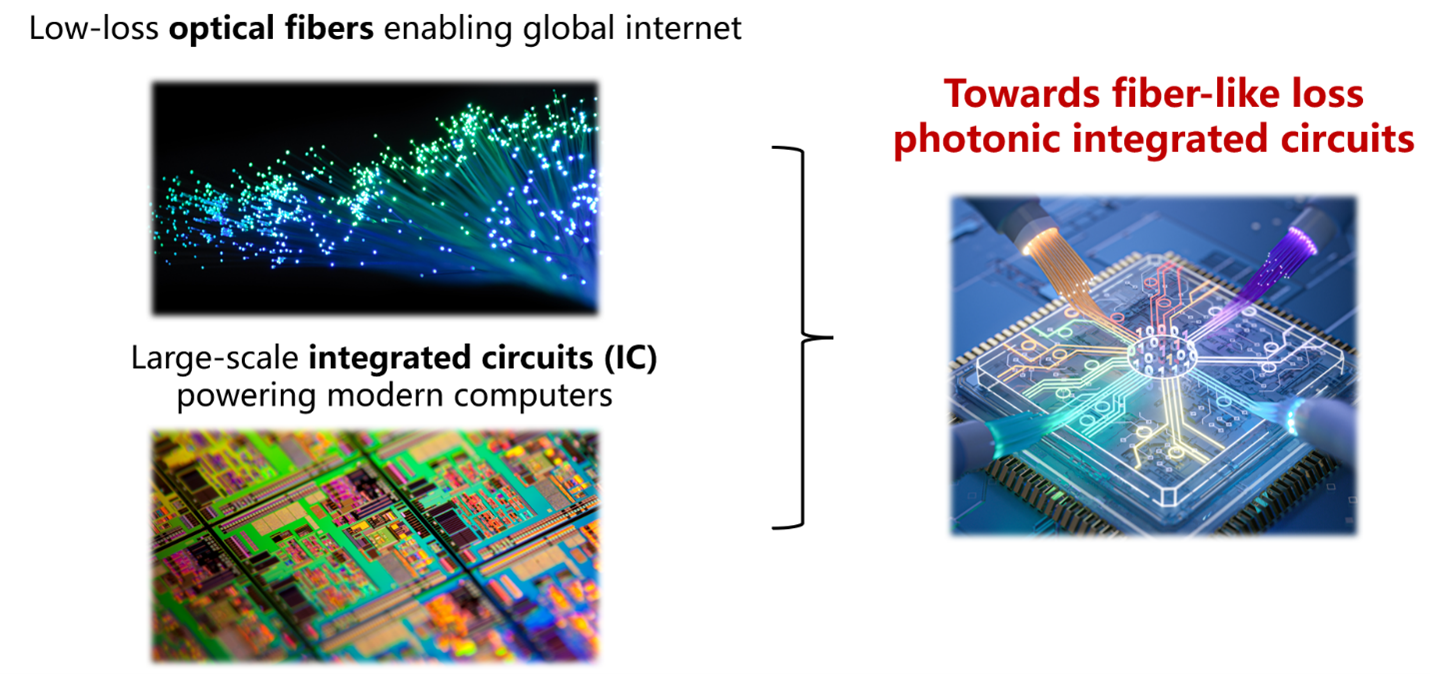
From optical fiber and integrated circuits to a new photonic platform
The internet was built on low-loss optical fiber, while modern computing was enabled by large-scale integrated circuits. This project combines those two foundations by bringing the material logic of fiber into manufacturable photonic chips.
- Fiber-derived germanosilica adapted to a CMOS-foundry-compatible process
- A scalable route to ultralow-loss photonic integrated circuits
- A platform view that unifies communications, computing, and precision measurement
Technical innovation
The key invention is a wafer-scale self-smoothing process. Higher GeO2 doping than in standard fiber lowers the glass softening temperature, enabling reflow in a foundry-compatible furnace. Surface tension then smooths rough waveguides to atomic-scale roughness, removing scattering loss at its source.
- Wafer-scale reflow smooths rough waveguides after fabrication
- Scattering loss is suppressed at its physical origin
- Coherence is upgraded across visible-to-infrared integrated photonics
- The platform supports coherent lasers, Brillouin devices, and microcombs
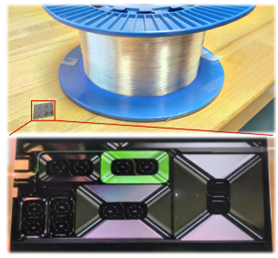
A comparison of a optical fiber spool and the new spiral waveguide chip.
Why low loss matters
Lower loss is not just a better device metric — it is the difference between a laboratory demonstration and a deployable photonic system.
Lower power
Every lost photon demands more laser power. Ultralow-loss photonic chips can reduce the power overhead of optical interconnects and coherent light sources.
Lower heat and noise
Loss translates into heating, instability, and degraded phase coherence. Reducing scattering directly improves precision and scalability.
More deployable systems
Compact, manufacturable, and low-loss photonics can move precision technologies out of the lab and into real-world use.
What this platform enables
This project establishes a shared foundation for multiple future photonic systems rather than a single isolated device advance.
AI optical interconnects
Lower-loss photonic chips can reduce laser power, heat, and electricity use in optical interconnects, supporting more sustainable growth in data-center infrastructure.
Precision timing & navigation
Higher coherence and compactness can shrink precision timing and navigation systems for space applications and GPS-denied environments.
Large-scale quantum systems
Over the longer term, ultralow-loss integrated photonics can support scalable quantum photonic architectures and new tools for discovery in chemistry, materials, and medicine.
Selected outputs and media
For a quick introduction to the project, the most useful materials are the paper itself together with concise external coverage.
Nature paper
The central technical paper describing fibre-like loss photonic integration from violet to near-infrared.
Read the paperCaltech News
An institutionally curated overview of the project, useful for broader scientific and public audiences.
Read the featureOFC official news release
Conference recognition highlighting the project’s significance for precision and quantum photonics.
Read the releaseMIT Technology Review China
Media coverage emphasizing the project’s relevance to precision measurement, AI computing, and quantum technologies.
Read the article